Can You Put New Skin on a Dog
My canis familiaris has a big open wound and my veterinarian recommended leaving it open to heal rather than repairing it with sutures. Why is this?
Wounds vary co-ordinate to:
Crusade - puncture wounds, abrasions, or lacerations
Location - paws, abdomen, optics, etc.
Level of contamination - clean (surgical) wounds, contaminated (infected)
Your veterinary has considered all of these factors when deciding the best way to care for a specific wound. Sometimes the location or the amount of pare loss prevents surgical closure or bandaging (wounds on the face or high up on the leg).
Sometimes, puncture wounds or other trauma force bacteria deep into the tissues. A contaminated wound that is more a few hours old should never be closed without surgical debridement (removal of all the contaminated or dead tissue), and in some cases this may result in more permanent damage than treating the wound medically and leaving information technology open up to heal.
What will be done for my dog'southward wound?
Abscesses may be lanced and cleaned under heavy sedation or anesthesia. A latex drain will exist placed to forbid the wound from closing besides speedily in social club to allow proper drainage and prevent the further build-up of infection.
"Wherever possible a wound will be closed and sutured in order to speed healing."
Wherever possible, a wound will be airtight and sutured in gild to speed healing. However, if there is gross contamination or deep infection present, the wound will be left open for topical treatment and to ensure drainage.
Your veterinarian may need to anesthetize your dog to remove strange material and dead tissue from the wound. If the wound cannot be surgically closed, your veterinarian may apply a protective bandage if this is possible. Your canis familiaris will receive oral or injectable antibiotics (such every bit amoxicillin-clavulanate or cefazolin).
How volition I need to care for this open up wound? 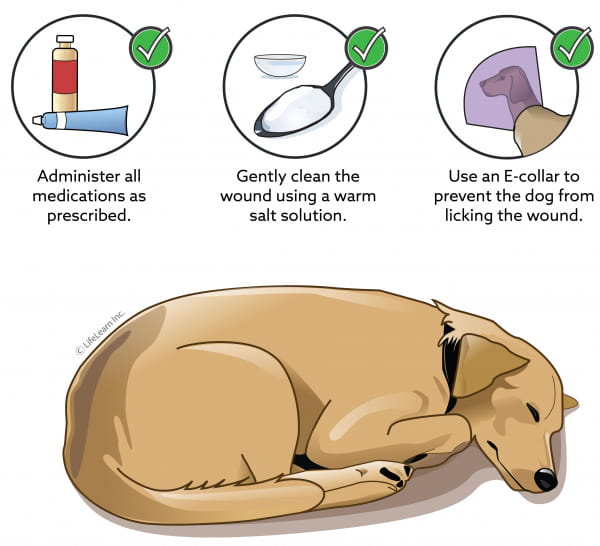
When your pet was discharged from the hospital, you received specific instructions regarding your pet's home intendance. Some full general care guidelines include:
- Information technology is important that the wound and surrounding area is gently cleaned to remove any crusty or sticky droppings. This volition keep the wound edges clean, reduce the potential for re-infection, and allow new healthy tissue to develop.
- Administer all of the medications every bit prescribed. Practice not discontinue antibiotics for any reason unless you lot have been specifically instructed to practice so by your veterinarian.
- Your dog should non be allowed to lick or chew the open wound. Many dogs volition require a protective collar (see handout "Elizabethan Collars in Dogs" for more data) to prevent them from injuring the site.
- It is important to prevent the skin from healing over the wound besides apace. This is specially important with abscesses that have been lanced and tuckered surgically. If the wound closes prematurely, the take chances of recurrence increases.
How do I prevent the wound from closing as well early on?
When cleaning the wound, gently massage the surrounding peel to open the wound and promote drainage. You may note some discharge or bleeding when you do this. Annotation whether it appears to exist infected (a thick or colored discharge) or if it is a articulate thin fluid. You should remove or let either type of belch to drain away. If the discharge continues to be bloody, green, or yellowish for several consecutive days, contact your veterinary for instructions.
What should I clean the wound with?
Warm tap water is recommended for cleaning well-nigh wounds. Warm saline (table salt solution) may besides be used. This may be fabricated by adding approximately one level teaspoonful (5 mL) of salt (or Epsom salts) to ii cups (500 mL) of h2o. In some cases, your veterinarian may recommend using a dilute cleansing solution of chlorhexidine, a surgical lather, or an iodine solution to help remove debris.
"Practise Non utilise soaps, shampoos, rubbing booze, hydrogen peroxide, herbal preparations, tea tree oil, or whatsoever other production to clean an open wound."
DO NOT use soaps, shampoos, rubbing alcohol, hydrogen peroxide, herbal preparations, tea tree oil, or any other production to make clean an open wound, unless specifically instructed to do then by your veterinarian. Some of these products are toxic if taken internally, while others can actually delay healing.
Can I non use mild antiseptics?
Your veterinarian may prescribe antibiotics or a suitable antibiotic cream to utilise to the wound. Since animals tend to lick and chew at wounds, inadvertently swallowing medications that are practical topically, or disinfectants and antiseptics intended for human being utilize are rarely suitable for utilise in animals.
What should I do if my domestic dog tries to lick the wound? 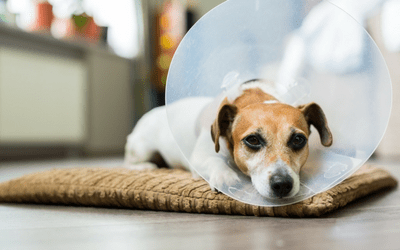
Many people accept the mistaken belief that dog's saliva is somehow antiseptic. This is far from the truth, especially when 1 considers how dogs groom themselves or greet each other. A dog will instinctively lick at a wound, but this can seriously delay healing. Therefore, you must prevent this by any means possible. Elizabethan collars are the nearly commonly used protective device. Other options, depending on the location of the wound, include covering the wound with a bandage, a stockinette, a dog glaze, or a t-shirt.
What almost pain medications?
Your veterinarian will prescribe advisable medications to relieve hurting and discomfort. Once a wound has begun to heal, information technology is no longer every bit painful. Your veterinarian will assess the individual state of affairs and make up one's mind the about advisable medications for your canis familiaris. Pain medications nigh typically prescribed are non-steroidal anti-inflammatory drugs (NSAIDs) such as meloxicam (Rheumocam, Metacam®), deracoxib (Deramaxx®), or carprofen (Rimadyl®).
Source: https://vcahospitals.com/know-your-pet/care-of-open-wounds-in-dogs
0 Response to "Can You Put New Skin on a Dog"
Post a Comment