After Reading the Above Statement, Did You Miss Any Species in Your Gut Content
IELTS Reading
True, False, Not Given Questions
Truthful, False, Non Given questions come up regularly in the IELTS Reading test.
Many students fright this type of question and I'll explain why in a minute. However, if you learn the tips and practice the strategy on this page, you'll shortly improve your skill at answering them.
Here'south what we'll be roofing:
- Explanation
- The big challenge
- Deviation betwixt T/F/NG & Y/N/NG questions
- 8 Top tips
- Proven strategy
- Examples & model answers
Explanation
For True/False/Non Given questions, you will be given a set of statements and a text. Your task is to determine which of the post-obit applies to the information in each statement:
- information technology agrees with the information in the text – Truthful (T)
- it disagrees with it or contradicts it – False (F)
- it is not mentioned in the text – NOT GIVEN (NG)
Hither's a fix of sample instructions & questions from a existent past IELTS Reading test paper for illustration.
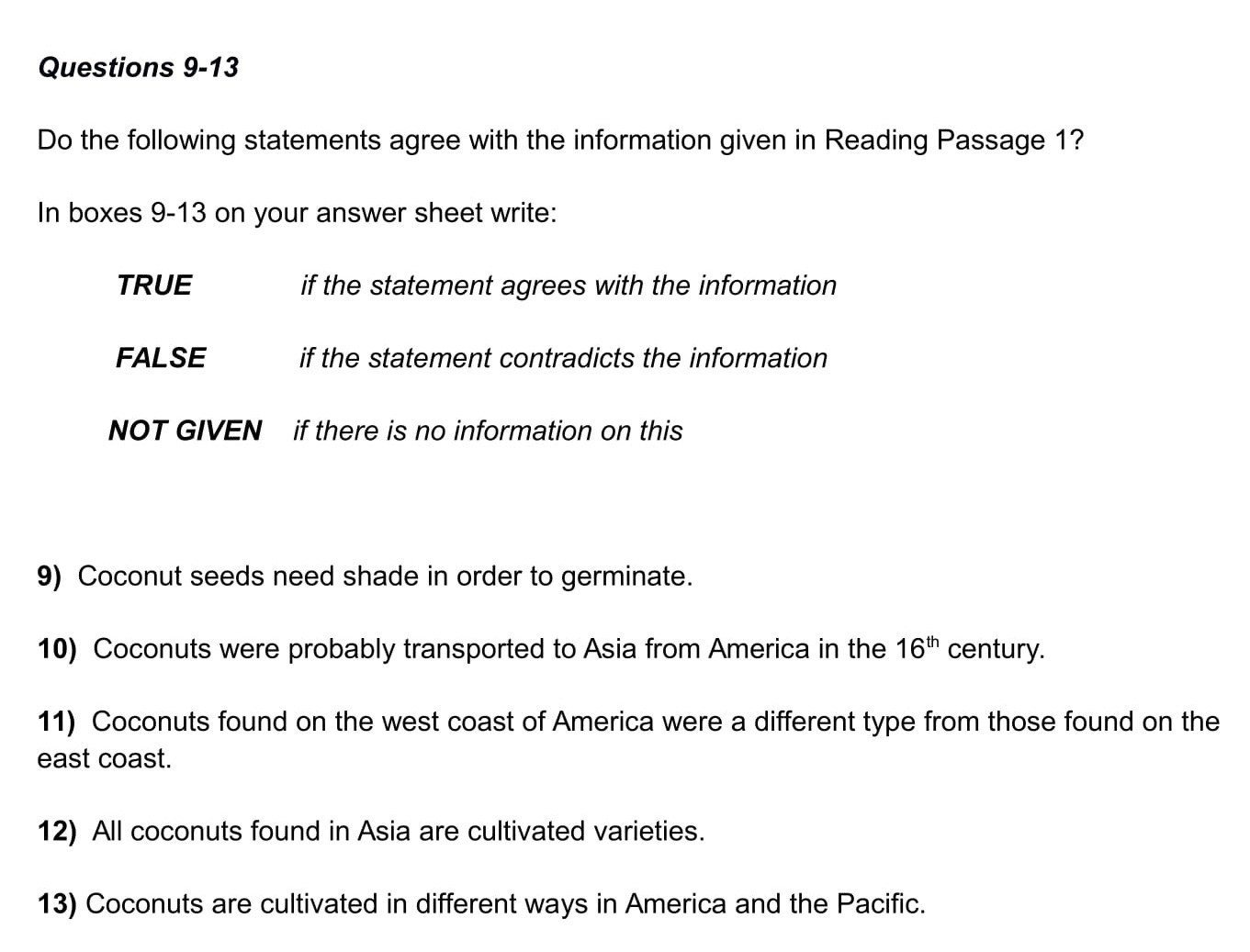
So, yous need to do ii things:
i) Understand the data in the statements.
ii) Decide if it is True, Imitation or Not Given co-ordinate to the text.
The large challenge
The claiming with a T/F/NG blazon question is that for some statements, the NOT GIVEN ones, y'all will be searching for information that'snon there.
This is the outset reason why some people fright information technology.
It's very easy to waste material a huge amount of time going over and over the text to check that you oasis't missed the data.
The 2d challenge is the unfamiliarity of this type of question. Nearly people will have looked for True & FALSE statements in a text back in their schoolhouse days but may have no experience of NG statements.
Hence, it's extra important to have a strategy that gives yous the confidence to brand your decision and move swiftly on.
Deviation between True/Faux/Not Given & Yes/No/Not Given questions
Some students get dislocated between True/False/Not Given questions and Yes/No/Not Given questions so I'll rapidly explain the difference.
It's all nearly the type of information contained in the text.
Truthful/Fake/Not Given –the text volition containfactual information nearly a topic.
Yes/No/Non Given –the text volition comprise theopinions, views or beliefs of the writer or other people who are mentioned.
8 Top tips
1) The answers appear in the aforementioned order in the text as the society of the statements.
2) You don't need to read the whole text. First, you will scan for keywords and then you'll read in item the department in which they're located for the answer.
3) There will be at least i of each reply blazon – Truthful, False, Not Given. So, if you don't have at least one of each when you lot've completed the question, you've made a error.
4) Watch out for distractors. Be aware that the exam setters dearest to utilize 'distractors' to really test you. A prime number case is qualifying words such as:
every a few
all always
some ofttimes
nearly occasionally
These single words can completely change the significant of a sentence.
E.yard. Tiantian often meets upwards with her friends subsequently piece of work.
Tiantian occasionally meets up with her friends later on work.
In T/F/NG questions, the meaning of the statement must exist an exact match with the data in the text to be TRUE.
5) Also exist on the lookout for qualifying words that express possibility or doubt such as:
seem claim
suggest possibly
believe probably
Once again, they tin totally alter the meaning of a statement.
Eastward.grand. Scientists now merits that several dissimilar species of humans evolved on the world.
Scientists at present know that several unlike species of humans evolved on the world.
6) The statements won't be a word-for-word match to the information in the text. They will contain synonyms and paraphrasing. It'south the significant that you are trying to match.
7) The test is not an assessment of your knowledge of the topic just only of your ability to read and empathise the specific information in the text. So, if y'all happen to know from your own noesis that a particular statement is correct, i.e. Truthful, but this is not stated in the text, your answer must be NOT GIVEN.
8) Call up that at least ane respond will be NG. This means that y'all will be searching for data that is not there.
Equally already mentioned, it's like shooting fish in a barrel to waste fourth dimension searching and searching for information you lot're never going to find because information technology isn't there. Utilise the strategy I'm about to show yous to quickly come to a decision about each argument and move on.
The Strategy
# 1 Read the instructions carefully. Double-check whether it is a TRUE/FALSE/NOT GIVEN or a YES/NO/NOT GIVEN question.
# ii Read the statements and try to understand the meaning of each. Do this before reading the text.
# 3 Think about possible synonyms that might announced in the text and note any qualifying words in the statements such as, all, some, always, often. This will brand your brain alerts for them when you scan the text.
# 4 Underline keywords. You won't necessarily detect the verbal words in the text due to the extensive utilize of synonyms and paraphrasing in T/F/NG questions but enough will exist present to make doing this worthwhile.
# five Re-read statement 1 and scan the showtime paragraph, perchance two, for the keywords or synonyms of them. Scanning will locate where the answer is but detailed reading of this section of the text is now needed to decide if the specific information you're looking for is True, Imitation or NOT GIVEN.
# 6 Make your decision. Call back to consider these three things:
- To be True, the information must exactly lucifer even if the words are unlike.
- Look carefully for qualifying words that might modify the significant.
- If you lot are struggling to find the answer it's probably because it isn't there, i.e. it's Not GIVEN.
# 7 Echo this procedure for the remaining questions.
Example with answers
Please note that this example is non from a real IELTS Reading test paper. I have created it myself to demonstrate the strategy I've but outlined and to give you lot an opportunity to practice it.
The text in your test will be longer and probably have five or vi statements.
Follow steps i-vii of the strategy and see if you can work out if each statement is TRUE, FALSE or NOT GIVEN. Then read my notes below which comprise the answers.
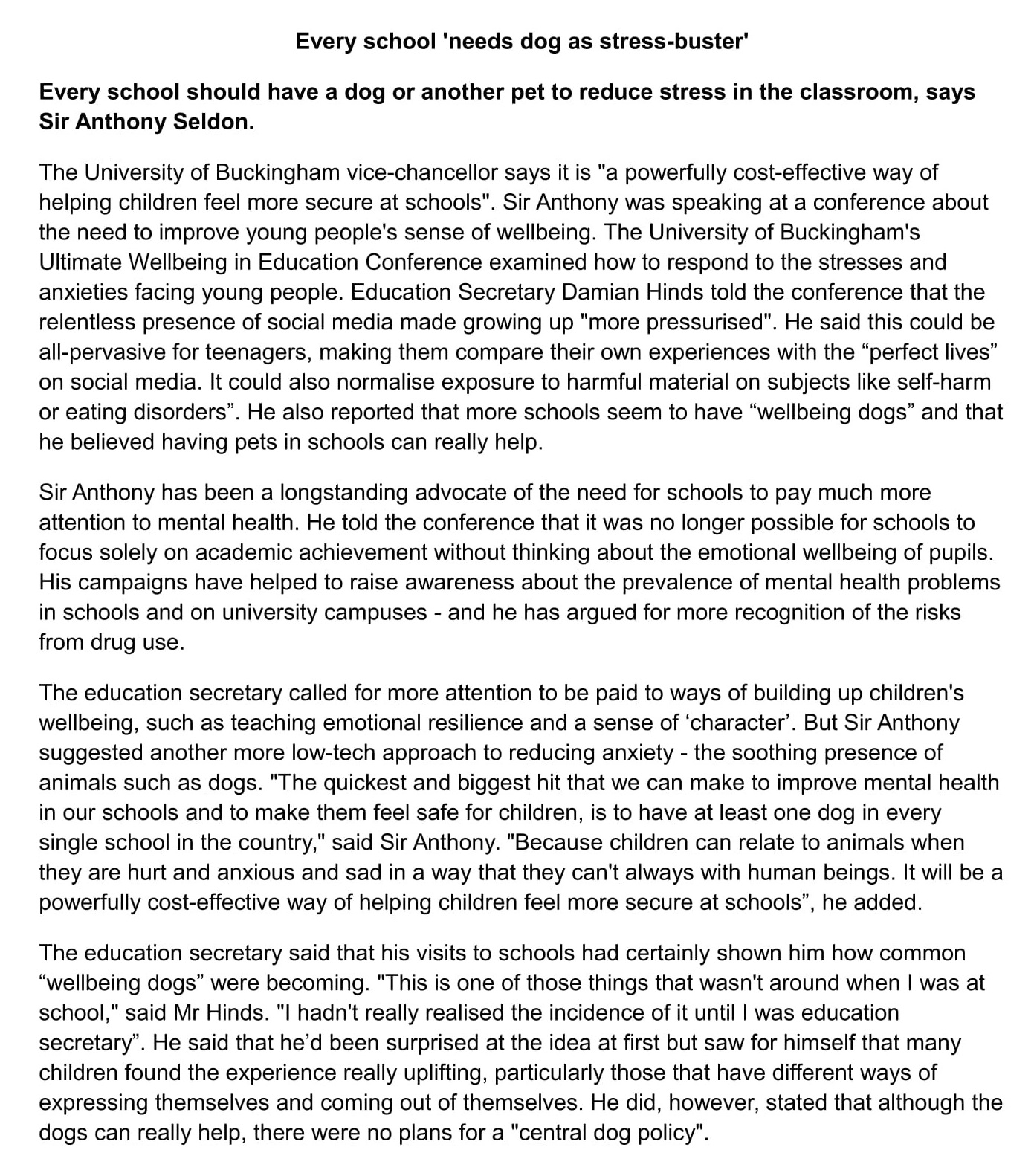
Download the PDF of this text – Reducing Stress in the Classroom
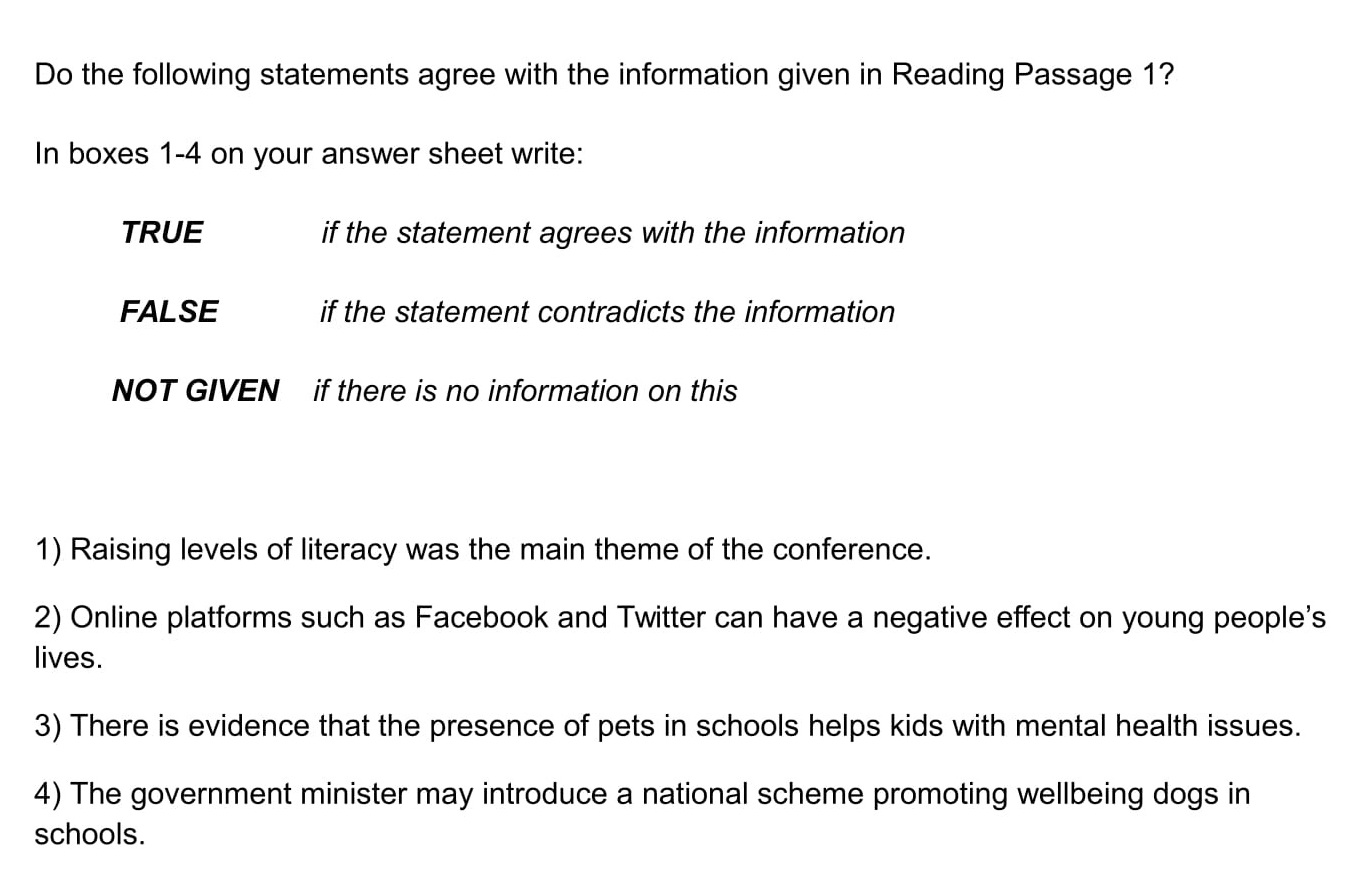
Download the PDF of these instructions – Reducing Stress in the Classroom - Statements
Notes on how I answered the questions
1) Having read the instructions and tried to sympathise the meaning of the statements, I now focus in on the kickoff argument.
1. Raising levels of literacy was the primary theme of the conference .
The keyword I select to scan for is conference . I'm fairly sure I'll discover this or a synonym because information technology has an article give-and-take in front of information technology (the) which makes it the subject area of the judgement.
I volition then need to search the text to see if 'raising levels of literacy' really was the main theme of this conference.
I scan the first primary paragraph and observe 'briefing' twice. I read both sentences that contain it in detail.
Sir Anthony was speaking at a conference about the need to improve young people's sense of wellbeing. The Academy of Buckingham's Ultimate Wellbeing in Education Conference examined how to respond to the stresses and anxieties facing young people.
It is very clear that the conference was most the wellbeing of the pupils, non their level of literacy. The answer is thereforeFaux.
2) Adjacent, I read the second statement and decide to scan for words continued to the internet as this is what the argument is most.
2. Online platforms such as Facebook and Twitter can have a negative effect on young people'south lives.
I go on scanning from the location of the last reply. Remember, the data will come in order in the text.
I speedily spot the words 'social media' which appear twice. I read the two sentences in particular to wait for whatever matching words or phrases. I also see the word 'teenagers' which is a synonym of 'young people'. This is another inkling that at that place is a match of information.
Pedagogy Secretary Damian Hinds told the conference that the relentless presence of social media made growing up "more pressurised". He said this could be all-pervasive for teenagers , making them compare their own experiences with the "perfect lives" on social media .
However, I now need to determine if the specific information in the text matches that of the statement.
The wording is very unlike merely the text definitely states that social media, of which Facebook and Twitter are a major part, can have a negative issue on young people's lives.
So, the statement is Truthful.
3) Moving on to statement iii, I re-read it to ensure I sympathise the meaning so choose my keywords, in this case, 'pets' and 'mental health'. I then browse for these.
3. There is evidence that the presence of pets in schools helps kids with mental health issues.
I easily discover 'mental health' just at that place is no mention of 'pets' in this part of the text. I do, still, spot the words 'animals' and 'domestic dog' which might take been used to paraphrase 'pets'.
I read in detail to get the meaning of the text.
Simply Sir Anthony suggested another more depression-tech approach to reducing anxiety - the soothing presence of animals such as dogs . "The quickest and biggest hit that we can make to amend mental health in our schools and to make them experience safety for children, is to have at least one dog in every single school in the country," said Sir Anthony. "Considering children can relate to animals when they are hurt and anxious and pitiful in a way that they can't always with man beings. Information technology will exist a powerfully toll-effective way of helping children feel more secure at schools", he added.
It seems to friction match the information in the sentence but there is another very important keyword in the argument that I need to consider – ' testify '. This means proof of the thought being suggested.
While the ideas match, there is no directly evidence stated so I mark the answer Not GIVEN.
You tin can encounter why NG answers tin can be challenging.
4) Moving on to the last statement, I select 'government minister' and 'national scheme' as my keywords and keep scanning the rest of the text for them. In this case, this means the final paragraph.
four. The government government minister may introduce a national scheme promoting wellbeing dogs in schools.
I don't find either of these phrases in the text so need to think about possible synonyms. Even if I know little about politics, I tin guess that the 'education secretary' is a 'government minister'. So that's a start.
The education secretary said that his visits to schools had certainly shown him how mutual 'wellbeing dogs' were becoming. "This is one of those things that wasn't effectually when I was at schoolhouse," said Mr Hinds. "I hadn't actually realised the incidence of it until I was education secretary ". He said that he'd been surprised at the thought at offset but saw for himself that many children establish the experience really uplifting, particularly those that accept unlike means of expressing themselves and coming out of themselves. He did, notwithstanding, stated that although the dogs tin really help, there were no plans for a "central dog policy ".
I scan again looking out for any other words related to government and politics and in the final sentence I also spot the word 'policy'.
It doesn't matter if you don't understand what this word means. All that matters is that yous can work out from the context of the sentence that this word is probably relevant and indicates where the answer is located.
I make an educated guess that a 'fundamental dog policy' is a match for a 'national scheme promoting wellbeing dogs in schools', and re-read the sentence to find my respond.
The sentence states that there are 'no plans for a key dog policy', so the answer is FALSE.
Answers
1 FALSE
two Truthful
3 Not GIVEN
4 Faux
Want to watch the video of this page? Click hither.
I hope you've found this page helpful. You are now ready to practice this strategy with by examination papers. Once you become the hang of answering T/F/NG questions, you'll be able to tackle them with conviction in your IELTS Reading exam.
Like this page?
Lessons On All Question Types
For more sample questions with pace-by-step instructions, see theIELTS Reading menu page.
- Dwelling ›
- IELTS Reading ›
- Truthful/False/Not Given
-
Back To Tiptop
Source: https://www.ieltsjacky.com/ielts-reading-true-false-not-given.html
0 Response to "After Reading the Above Statement, Did You Miss Any Species in Your Gut Content"
Post a Comment