Most Common Zither in Arabic Art Music Is the
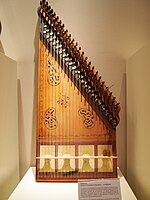
 National Museum of Ethnology, Osaka – Qanun – Cairo in Egypt – Made in the 1990s | |
| String instrument | |
|---|---|
| Classification |
|
| Developed | Antiquity |
| Playing range | |
| (F2)A2-E6(G6) | |
| Related instruments | |
| |
Kanun music during the 5th anniversary of Wikimedia Armenia
The qanun, kanun, ganoun or kanoon (Standard arabic: قانون, romanized: qānūn ; Sorani Kurdish: قانون, romanized: qānūn ; Greek: κανονάκι, romanized: kanonaki ; Hebrew: קָאנוּן, qanun; Western farsi: قانون , qānūn; Turkish: kanun; Armenian: քանոն, romanized: k'anon ; Azerbaijani: qanun; Uighur: قالون, romanized: qalon ) is an Arabic string instrument played either solo, or more oftentimes equally part of an ensemble, in much of the Centre East, North Africa, West Africa, Cardinal Asia, and Greece. The name derives from the Arabic word qanun, meaning "rule, law, norm, principle". Traditional and Classical musics executed on the qanun are based on Maqamat. The qanun traces one of its origins to a stringed Assyrian instrument from the Old Assyrian Empire, specifically from the nineteenth century BC in Mesopotamia.[1] This instrument came inscribed on a box of elephant ivory plant in the former Assyrian capital Nimrud (aboriginal name: Caleh).[1] The instrument is a blazon of large zither with a thin trapezoidal soundboard that is famous for its unique melodramatic sound.
Regional variants and technical specifications [edit]
Arabic qanuns are usually constructed with v skin insets that support a single long span resting on five arching pillars, whereas the somewhat smaller Turkish qanuns are based on merely four. This allows Arabic variants of the instrument to have more room for the installation of farthermost bass and treble strings. Kanuns manufactured in Turkey by and large feature 26 courses of strings, with three strings per course in the case of all regional variants. Contemporary Arabic designs use Nylon or PVF strings that are stretched over the bridge poised on fish-skins as described on one terminate, and attached to wooden tuning pegs at the other end.
Ornamental sound holes called kafes are a critical component of what constitutes the accustomed timbre of qanun. However, they commonly occupy dissimilar locations on the soundboard of Turkish kanuns compared to Arabic qanuns, and may as well vary in shape, size and number depending on geography or personal taste.
The dimensions of a Turkish kanun are typically 95 to 100 cm (37–39") in length, 38 to 40 cm (15–16") in width, and 4 to 6 cm (1.5–ii.3") in height.[ii] In contrast, an Arabic qanun measures a bit larger as mentioned.[3]
Qanun is played on the lap while sitting or squatting, or sometimes on trestle support, by plucking the strings with two tortoise-trounce picks (i for each manus) or with fingernails, and has a standard range of three and a one-half octaves from A2 to E6 that tin can exist extended downwardly to F2 and up to G6 in the case of Arabic designs.
The musical instrument likewise features special metallic levers or latches under each course called mandals. These small levers, which can be raised or lowered quickly by the performer while the instrument is being played, serve to slightly change the pitch of a detail course past altering effective string lengths.[four]

Arab qanun performer in Jerusalem, 1859. Thomson, p. 577.
Tuning and temperament [edit]
On the regular diatonically tuned qanun, mandal technology was first implemented, according to Turkish musicologist Rauf Yekta, some xxx years prior to his submission of his invited monograph on Turkish Music to the 1922 edition of Albert Lavignac's Encyclopédie de la Musique et Dictionnaire du Conservatoire.[five] Levantine qanuns, prior to that time, remained rather inflexible and cumbersome to perform on (specially as demanding modulations/transpositions came into vogue that were increasingly emulating Western tonality and cardinal changes), requiring the player to use the fingernail of the thumb to depress on the leftmost ends of the courses to achieve on-the-wing intervallic alterations.
With the appearance of electronic tuners some decades subsequently, standardization of the placement of reference mandals on the qanun began. While Armenian kanuns[vi] now employ only equidistant half-tones and Standard arabic qanuns exact quarter-tones as a result, Turkish kanun-makers went so far as dividing the electroacoustically referenced equal-tempered semitone of 100 cents into 6 equal parts, yielding – for all intents and purposes – 72 equal divisions (or commas) of the octave pitch resolution.[7] Not all pitches of 72-tone equal temperament are available on the Turkish kanun, withal, since kanun-makers affix mandals that just accommodate modulations/transpositions popularly demanded by performers. This has subsequently led to the familiar interrupted and irregular pattern of mandals on the Turkish kanun condign a visual guide for players, in facilitating modal and intonational navigation on an instrument which is commonly bereft of pitch markers. Some kanun-makers may as well choose to split up the semitone distance from the nut of the lower registers into 7 parts instead for microtonal subtlety (and the highest registers, conversely, into five parts due to spacing constraints); but practise then at the expense of octave equivalences. Despite the mentioned discrepancies, hundreds of mandal configurations are at the player's disposal when performing on an ordinary Turkish kanun.
On the other hand, the nowadays widespread application of equidistant 24-tones on Standard arabic and 72-tones on Turkish qanun models presents an ongoing source of controversy.[8] [9] This is particularly in regards to how adequate such Eurocentric octave divisions are in faithfully reproducing the traditionally or classically understood fluid pitches and inflexions of Standard arabic music or Ottoman classical music scales. Pitch measurement analyses of relevant audio recordings reveal that, equal temperaments based on bicycle-chained "multiples of twelve" are substantially not compatible with authentic Centre Eastern performances; substantiating the notion instruments strictly based on them would disharmonism audibly with a justly tuned/intoned tanbur, oud, ney, or kemenche.[10] [11]
Alternating tuning approaches for the qanun thus likewise exist. Turkish music theorist Ozan Yarman has proposed, for example, an academical 79-tone temperament for the expression inside tolerable error-margins of Maqamat / Makamlar / Dastgaha at all pitch levels, that was implemented by the renowned late luthier Ejder Güleç (1939–2014)[12] on a Turkish kanun.[13] Also, the late Swiss-French qānūn performer Julien Jalâl Ed-Dine Weiss (1953–2015), who was disquisitional of the tuning deficiency of Eurocentric octave divisions in approximating just intervals, is known to accept conceived, since 1990, a number of prototypes that were entirely based on low prime-limit or uncomplicated integer ratio Pythagorean and harmonic intervals; which were one time again built, on instructions from Weiss, by Ejder Güleç.[14]
Notable players [edit]

Kanûnî, from Rålamb Costume Book, 1657.
- Aytaç Doğan
- Mohammad-abdo Saleh
- Petros Tabouris
- Ara Topouzian
See as well [edit]
- Çeng
- Psaltery
- Santur
- Zither
References [edit]
- ^ a b "Qanoon". furatmusic.com.
- ^ Aydoğdu, Gültekin; Aydoğdu, Tahir (2018-02-xi). "'Kanun' hakkında". turksanatmuzigi.org: Salih Bora.
- ^ "About The Qanun". www.middleeasterndance.net . Retrieved 2016-06-26 .
- ^ Kassabian, Anahid (2013). Ubiquitous Listening: Affect, Attention, and Distributed Subjectivity. Academy of California Press. pp. 79–. ISBN978-0-520-27515-vii.
- ^ Nasuhioğlu, Orhan (December 1986). Türk Musikisi – Rauf Yekta Bey. Pan Yayıncılık. pp. 92–93.
- ^ McCollum, Jonathan (2015). "Kanoun". Grove Music Online. doi:10.1093/gmo/9781561592630.commodity.L2285837. ISBN978-1-56159-263-0 – via Oxford Music Online.
- ^ Yarman, Ozan (2008). 79-tone Tuning & Theory For Turkish Maqam Music As A Solution To The Not-Conformance Betwixt Electric current Model And Practice (PDF). Istanbul Technical Academy: Plant of Social Sciences: unpublished Doctoral Dissertation. pp. 2–iii, 92, 126.
- ^ Aydoğdu, Tahir; et al. (2012). "one. ULUSLARARASI KANUN SEMPOZYUMU VE FESTİVALİ Plan ve Özetler" (PDF). (I. International Qanun Symposium & Festival). Archived from the original (PDF) on 2016-x-23. Retrieved 2016-06-27 .
- ^ Aydoğdu, Tahir; et al. (2015). "2. ULUSLARARASI KANUN SEMPOZYUMU VE FESTİVALİ synopsis". (Two. International Qanun Symposium & Festival).
- ^ Bozkurt, Barış; Yarman, Ozan; et al. (2009). "Weighing Diverse Theoretical Models on Turkish Maqam Music Against Pitch Measurements: A Comparison of Peaks Automatically Derived from Frequency Histograms with Proposed Scale Tones" (PDF). Periodical of New Music Research. 38 (1): 45–seventy. doi:10.1080/09298210903147673. hdl:11147/2853. S2CID 57766225.
- ^ Signell, Karl (1977). Makam – Modal Practice in Turkish Art Music. Washington: Asian Music Publications. pp. 37–47, 151–61.
- ^ Güleç, Levent & Bülent. "Ejder Müzik Aletleri". world wide web.ejdermuzik.com . Retrieved 2016-06-27 .
- ^ "79-tone qanun recipe". www.ozanyarman.com . Retrieved 2016-06-26 .
- ^ Pohlit, Stefan (2011). Julien Jalâl Ed-Dine Weiss: A Novel Tuning Organisation for the Middle-Eastern Qānūn. Istanbul Technical University: Plant of Social Sciences: unpublished Doctorate Dissertation.
Further reading [edit]
- Farraj, Johnny; Shumays, Sami Abu (2019). Within Arabic Music: Arabic Maqam Functioning and Theory in the 20th Century. Oxford: Oxford Academy Press. ISBN978-01906-five-835-ix.
External links [edit]
- William McClure Thomson, (1860): The Land and the Volume: Or, Biblical Illustrations Fatigued from the Manners and Customs, the Scenes and Scenery, of the Holy Land Vol 2, p. 577.
Source: https://en.wikipedia.org/wiki/Qanun_%28instrument%29
0 Response to "Most Common Zither in Arabic Art Music Is the"
Post a Comment